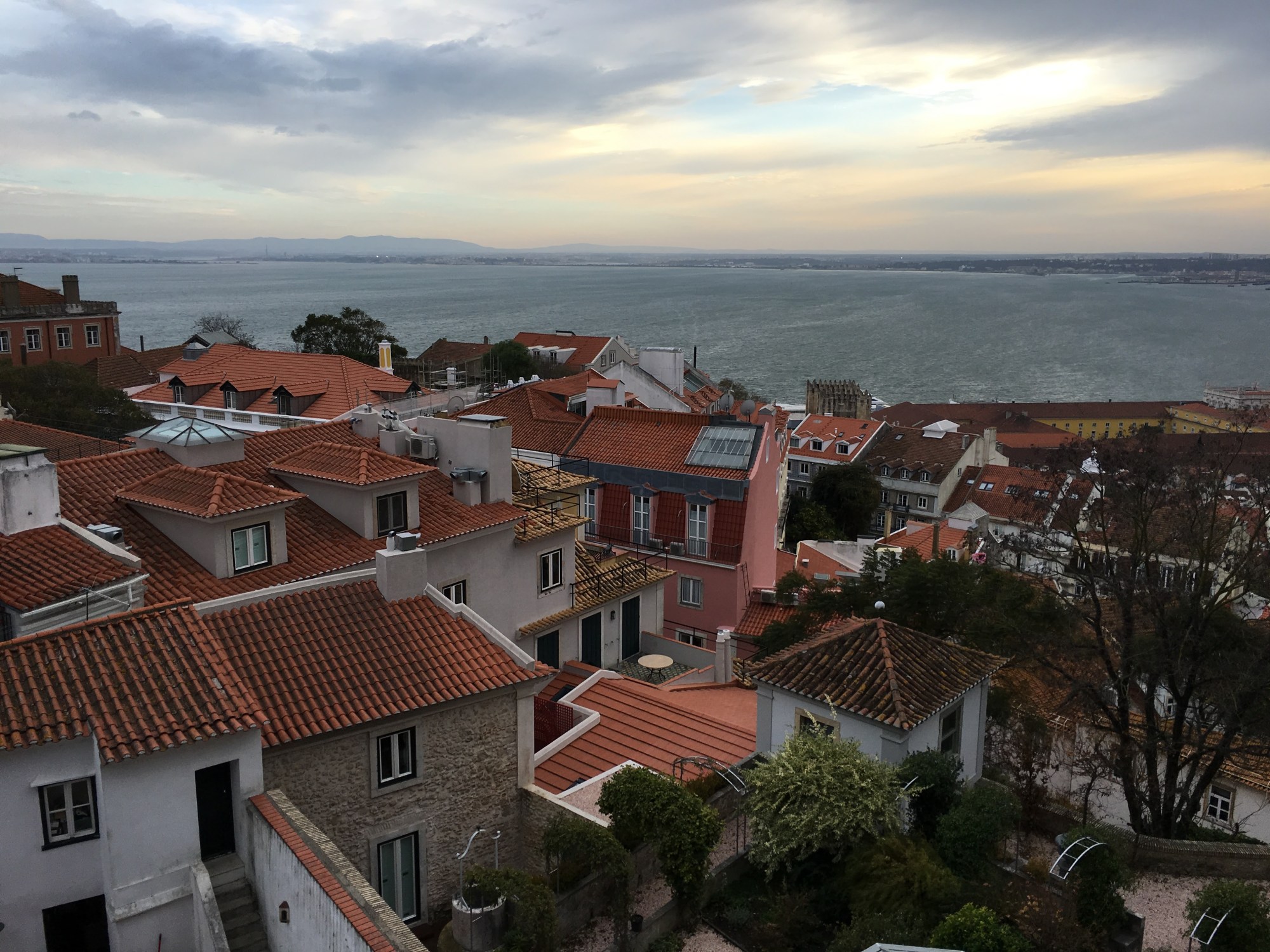
I managed to escape the cold and clouds of Germany last December for the relatively warm and sunny city of Lisbon. My typical pre-trip research prepared me for the architecture and tasty food, but didn’t prepare me for the unpolished beauty and charm of the place.
After grabbing breakfast, I made a beeline for the Praça do Comércio, one of the city’s biggest squares. The square is bordered by the Tajo River on one side and is surrounded by buildings and an impressive ceremonial gate. From the plaza, I took a solo walking tour of some of Lisbon’s impressive squares, churches, and markets. One of the churches on this walk was rebuilt with the materials from the original church that was destroyed in a massive, city-leveling earthquake in the 1700s.
I walked from plaza to plaza, each with a different pattern of white and black cobblestones. One of them, Figueira Square, had an outdoor market on which provided the opportunity to try 80 year old port with traditional Portuguese cheese. After befriending a bartender at the market, I learned all about Portugal’s tiny craft beer scene while tasting beer from the 8a Colina brewery. The brewery is named after Lisbon’s eight hills, which are prominently featured in a famous Portuguese poem that compares the hills to the seven hills of Rome. The local joke is that Lisbon is a better city than Rome, based solely on it having more hills.
After cheesing, porting, and beering in central Lisbon, I headed over to the Belem neighborhood to have lunch in a famous cafeteria called Pasteis de Belem. The ham and cheese toast was excellent and was served with a side of incredibly sour lemonade. The intricate tilework covering the extensive cafeteria was gorgeous and would be a sign of tiles to come. Near the cafeteria is the Santa Maria de Belem and the Jeronimos Monastery. Both buildings were built in a white stone, which contrasted beautifully with the blue sky.
Across a busy thoroughfare was a riverside park, featuring an impressive monument that honors explorers and travelers. The nearby fortification was gorgeously set next to the river, providing city defenders a place to string defensive chains across the river. These chains were designed to prevent ships from sailing up the river to attack Lisbon in ye olden times. The park also provided great views of a massive suspension bridge that looked suspiciously like the Golden Gate Bridge in San Fransisco.
The sun gently set across the river as I walked back towards the city center, where I met up with friends to check out the city’s oldest beer hall, Cervejaria Trindade. The restaurant was also home to a brewery, which offered typical German-style beers. The food was good, but the beers weren’t anything to send a telegram home over. After dinner, we headed over to the Praça do Comércio, which was currently featuring a Christmas-themed light and sound show. I thought this show would be sort of lame, but it turned out to be pretty intense and epic. Projectors covered the square’s buildings with images of elves, candy canes, and Santa while speakers overwhelmed the crowd with holiday-flavored music. Apparently the show changes every year and is a huge part of the city’s holiday tradition. After the light and sound show, we headed to a rooftop bar in the Baixa neighborhood for a nightcap.


The next day was spent checking out the Alfama neighborhood, one of the only parts of the city that survived the mid-1700s earthquake. The whole neighborhood was built an a steep hill which offered great views of the surroundings. Next up was the National Tile Museum. Now, I know what you’re thinking. Sounds kinda boring…how cool could tile be? Turns out, pretty interesting. The Portuguese love them some tile and the country is known throughout the world for their decorative and functional tile work. The museum was great, and even had a city panorama made from the country’s iconic blue and white tiles.
My friend and I checked out a flea market on our way uphill towards the Castle of Saint George. Situated at the top of the Alfama neighborhood, the castle literally commanded views of the entire city. As one does, I followed a lost-looking peacock around the castle for a few minutes until it flew up in a tree to get out of the sun. Turns out, that particular tree was quite popular with the local peacock (and peahen) population. It was filled with 15 other peafowl. As the sun was setting, we headed to the base of the Alfama neighborhood to check out the local Fado scene. Fado is an incredible soulful, beautiful, resonant, and frankly tragic sounding musical style. Fado is most commonly heard in live performances at restaurants and bars, where five or six singers interchangeably perform with two guitarists. The performance had a ton of audience participation and was incredibly fun. After the show, we discovered a great tapas place, Medrosa d’Alfama. It was so delicious, we went back a second time during the trip.


For our last day, we hopped on a train for the 45 minute trip to the mountain town of Sintra. The locale plays host to the many castles and palaces of the various Portuguese monarchies. First, we negotiated a trip up the steep hills of Sintra in a tuk-tuk to the Quinta da Regaleria, a relative newcomer to Sintra. The idyllic gardens were gorgeous, with small towers and what was made to appear like castle ruins dotted throughout. The Quinta da Regaleria is probably best known for it’s Initiation Well, with it’s stairs leading you down to a network of caves and moss-covered grottoes. After welling for quite some time, we headed over to the Pena National Palace, which was featured in bold technicolor. The palace overlooked the small town of Sintra and had beautiful views of the Atlantic Ocean. It was also possible to see the Moorish Castle of Sintra from the Pena Palace, but we didn’t have quite enough time to visit the stony fortification before heading back to Lisbon.


Lisbon and Sintra were incredible places to visit. Both were unstoppably beautiful and had plenty of what I had been lacking…sunshine. Three full days was the perfect amount of time to explore the area, but another day or two would have let me explore some of the national parks near Lisbon. My barber tells me that the surfing is also pretty good near the parks, as long as you’re equipped with a wetsuit or a sea lion-like insulating fat layer, you’ll be good to go.
 Travel Frankly